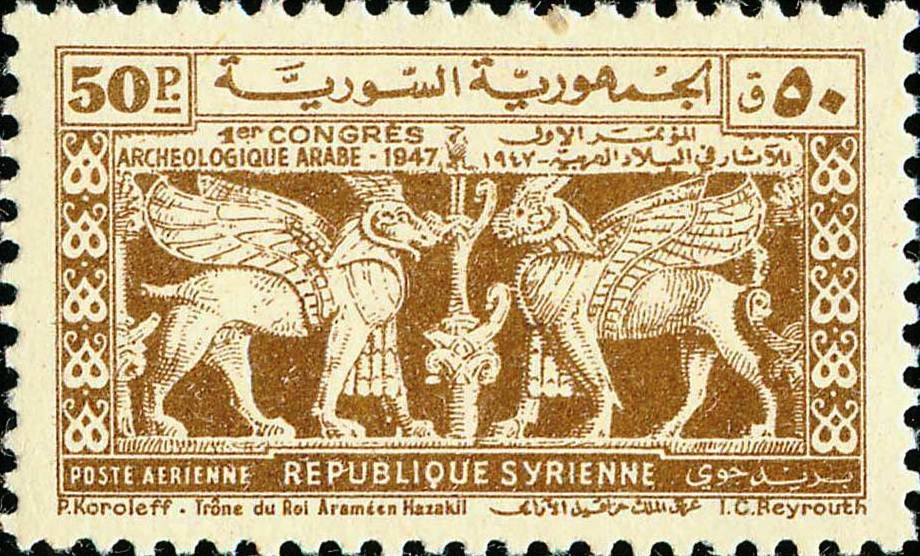
Ram-headed Sphinxes Carved in Ivory
This Syrian airmail stamp was issued in 1947 as a high-value denomination for the commemorative series honoring the First Arab Archaeological Congress (1er Congrès Archéologique Arabe / المؤتمر الأول للآثار في البلاد العربية). Printed in a rich golden-brown ink, the stamp carries a face value of 50 Piastres, designated by "50P." in the upper-left corner and "٥٠ ق" (Qirsh) in the upper-right. The top panel features the state's name, Al-Jumhuriyah as-Suriyah (الجمهورية السورية), while the lower frame is inscribed with "REPUBLIQUE SYRIENNE," flanked by "POSTE AERIENNE" on the left and its Arabic equivalent Barid Jawwi (بريد جوي) on the right. The bottom margin credits the artist Paul Koroleff (P. Koroleff) and the printer, the Catholic Press in Beirut (I.C. Beyrouth).
The central vignette illustrates an exquisite ancient ivory carving depicting two symmetrical, winged ram-headed sphinxes facing a stylized sacred tree. The lower margin explicitly identifies the artifact's historical association: "Trône du Roi Araméen Hazakil" (عرش الملك حزائيل الارامي), referring to King Hazael of the powerful ancient Aramaean kingdom of Damascus during the 9th century BCE. These famous ivory plaques were uncovered at Arslan Tash (ancient Hadatu) in northern Syria and are celebrated masterpieces of Phoenician and Aramaean craftsmanship that once adorned royal furniture. By featuring this Iron Age treasure, the stamp uniquely highlighted Syria's profound, ancient Semitic heritage to the congress delegates.
The central vignette illustrates an exquisite ancient ivory carving depicting two symmetrical, winged ram-headed sphinxes facing a stylized sacred tree. The lower margin explicitly identifies the artifact's historical association: "Trône du Roi Araméen Hazakil" (عرش الملك حزائيل الارامي), referring to King Hazael of the powerful ancient Aramaean kingdom of Damascus during the 9th century BCE. These famous ivory plaques were uncovered at Arslan Tash (ancient Hadatu) in northern Syria and are celebrated masterpieces of Phoenician and Aramaean craftsmanship that once adorned royal furniture. By featuring this Iron Age treasure, the stamp uniquely highlighted Syria's profound, ancient Semitic heritage to the congress delegates.